


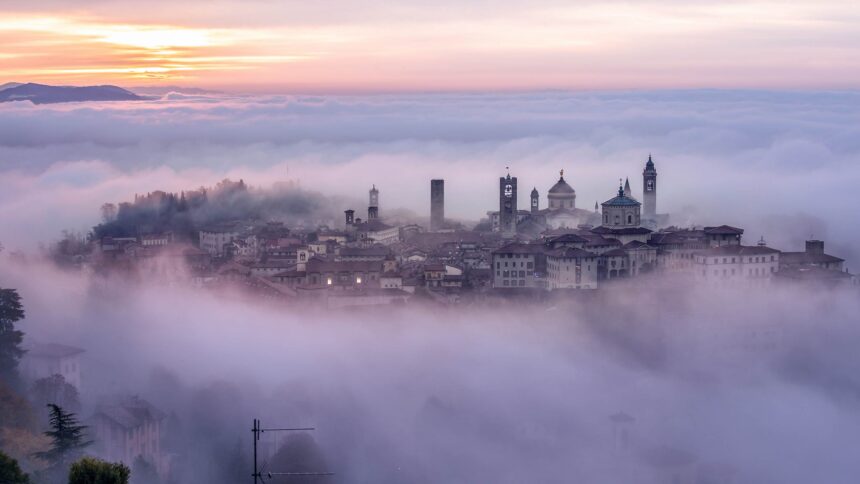
Three hidden UNESCO fortress cities: A Northern Italy road trip from Milan to Venice
Dip into 400 years of culture, history, and food — this is the road trip from Milan to Venice that nobody tells you about.
You could cover Milan to Venice in under three hours by train or on the autostrada, overtaking lorries past a blur of service stations. Or you could take a road trip that curves east through hilltop fortress cities, along the southern shore of Lake Garda, and deep into a corner of Italy that most travellers drive straight past without knowing it exists.
This is a road trip through the Venetian Works of Defence: three cities that make up a UNESCO World Heritage Site. The journey will take you through time to the Republic of Venice, which built, fortified, and held cities for five centuries across Northern Italy, Croatia, and Montenegro.Bergamo in the west, with its six kilometres of Renaissance walls crowning a hilltop medieval city, deserves your undivided attention. Peschiera del Garda, where a pentagon-shaped Venetian fortress rises straight from the turquoise water of Italy’s largest lake, is a treat for the senses. The most surprising town, Palmanova in the east, is a nine-pointed star city drawn on paper in 1593 and built exactly as designed, unchanged in 430 years.
Each city is extraordinary in its own way. Together, as a road trip, they tell the story of an empire. You fly into Milan, drive east through history and fly home from Venice. Or, if you are feeling ambitious, you venture further into Slovenia to explore another beautiful country.
At a Glance
The Road Trip — Key Details
Route
Milan → Bergamo → Peschiera del Garda → Palmanova → Venice
Total drive
~350 km / 3.5 hours total (excluding stops)
Duration
5–7 nights minimum · 7–10 nights for a relaxed pace
Fly in / out
In: Milan Malpensa (MXP) or Bergamo (BGY)
Out: Venice Marco Polo (VCE) or Treviso (TSF)
Car needed?
Yes — one-way hire from Milan → Venice is easy and affordable
Best time
March–June or September–October
UNESCO sites
3 cities inscribed in 2017 — Venetian Works of Defence

Why This Northern Italy Route: The Venice You’ve Never Seen
Most people think of Venice as a city. But for centuries, Venice was an empire.The Serenissima, or the Most Serene Republic, controlled trade routes from the Alps to the Adriatic, and built some of the most sophisticated defensive architecture the world had ever seen to protect its mainland territories.When gunpowder changed the rules of war in the early 1500s, Venice responded with a completely new kind of fortress: low, angled, star-shaped bastions designed to deflect cannon fire rather than absorb it. They created a network of fortifications so effective that enemies rarely succeeded in attacking them.
On this route, you’ll get to relive history via the preserved Venetian Fortress walls in three cities, experience local culture and indulge in an impeccable culinary journey. The three Italian cities on this route each tell a different chapter of that story.
Begin with Milan if it is your first visit to this part of the world. Just an hour away from the Fashion Capital lies our first stop: Bergamo.
Stop 1 -Bergamo: Where time stands still
2 Nights Recommended
Bergamo is the opening act of this road trip, and it sets a high bar. The city has two personalities: the modern Città Bassa below, and the Città Alta perched on a hilltop above, enclosed within six kilometres of Venetian walls built between 1561 and 1588. A short funicular connects the two, and when you emerge at the top, in the middle of a cobbled medieval city that has barely changed in four hundred years, you understand immediately why Bergamo carries two UNESCO designations: one for the fortress itself, and one for the historic city within.


Bergamo’s Venetian Walls — At a Glance
Walls Built
1561–1588
Commissioned by Venice to defend against neighbouring powers; designed in the “alla moderna” bastioned style
Wall Length
6 km
4 gates, 14 bastions, artillery platforms — built from Venetian brick and local stone
Città Alta Elevation
370 m
Naturally defended hilltop with views over the Po plain and Orobie Alps
The Rocca
Roman → Venetian
Strategic high point with continuous use from Roman Capitolium to Venetian tower and beyond
What to see and do in Bergamo
What makes Bergamo unusual is how seamlessly its history folds into everyday life. The Venetian walls are not distant monuments but part of the city’s rhythm — locals walk the ramparts for their evening passeggiata, children cycle along the grassy bastions, and buses still pass through the great stone gates.
The best way to understand them is to walk the full perimeter. It takes about two hours, and the perspective shifts constantly: the Alps rising to the north, the Po plain stretching south, the modern city below, and the medieval towers and domes of Città Alta just above you. Before you begin, a short visit to the Mura di Bergamo museum at Porta Sant’Agostino provides useful context for what you’re about to see.
From there, step into the heart of the upper city.
Piazza Vecchia is Bergamo’s quiet centre of gravity — composed, balanced, and almost theatrical in its restraint. The neoclassical Palazzo Nuovo faces the square with measured symmetry, while the medieval Campanone tower rises above it, its clock set into warm yellow stone. Climb to the bell chamber at the top; the view is one of the finest in northern Italy, and the city’s layered geography becomes immediately clear.


Just beyond the square, the tone shifts.
The Cappella Colleoni is one of the most intricate Renaissance facades in Italy — polychrome marble, diamond-pattern inlay, and finely carved reliefs that reward close attention. Next door, a simple doorway leads into the Basilica di Santa Maria Maggiore, where the interior unfolds unexpectedly: gilded ceilings, Flemish tapestries woven with gold thread, and a Baroque walnut confessional so elaborate it feels more like sculpture than furniture.
Enjoy the art in Bergamo
For those drawn to art, Bergamo offers something quieter but equally rewarding.
The Accademia Carrara is one of northern Italy’s most underrated museums, and worth setting aside an afternoon for. Its collection includes Lorenzo Lotto’s portrait of Lucina Brembati — one of the earliest Italian portraits set at night, with the subject’s name hidden in a visual puzzle in the moon — alongside Botticelli’s portrait of Giuliano de’ Medici and luminous Venetian views by Canaletto and Guardi. If you’re visiting before June 2026, the temporary exhibition on the origins of tarot cards adds an unexpected layer to the experience.
A short walk away, in the lower city, the GAMeC (Galleria d’Arte Moderna e Contemporanea) offers a striking counterpoint to everything you’ve just seen. Where the upper city preserves centuries, GAMeC engages with the present — rotating exhibitions, conceptual installations, and works that often respond to themes of identity, space and community.
One installation in particular lingers: a large-scale work inspired by a spider’s web — delicate, interconnected, almost invisible until you step closer. It’s a quiet echo of something you encounter again later in this journey, in Palmanova’s star-shaped design and its folklore of webs and geometry. In a road trip defined by fortifications — by walls designed to keep people out — this recurring motif of connection feels like an intentional counterpoint.


Where to Eat in Bergamo
Bergamo’s food identity is specific and fiercely local.
Begin in the evening, when the stone streets of Città Alta soften into warm light, and the trattorias fill slowly. Ol Giopì is the classic introduction: brick-vaulted ceilings, white tablecloths, and a cheese trolley that arrives with quiet ceremony — fifteen varieties, including the local Strachitunt DOP and Taleggio. The tagliolini ai 30 tuorli, a rich thirty-egg-yolk pasta finished with truffle, is the dish to order. Stay for dessert; the tiramisù, panna cotta, mousse or a fruit salad perhaps to balance it all out.
The following day, lunch at Nonna Alda continues the story. If you’ve taken the morning pasta class here, the transition is seamless — from learning to shape casoncelli by hand to sitting down to eat them. The risotto delle valli, made with Strachitunt DOP, sour cherry reduction and toasted walnuts, is an excellent pick for vegetarians.
And then, before you leave the city, there is one final stop. On Piazza Vecchia, La Marianna serves the gelato that Bergamo claims as its own: stracciatella – cream threaded with irregular shards of chocolate. Order it as a Caffè Marianna, an espresso poured over a scoop of gelato. It costs four euros. It feels like more.
Pasta-making class: You can make your Casoncelli and eat it too!
One of the most memorable experiences in Bergamo is a morning spent at Nonna Alda, learning to make casoncelli with Nonna Antonella. The process is as much about rhythm as technique — rolling the dough, filling each half-moon, folding and sealing them by hand.
The filling — meat, cheese, amaretti and candied citrus — sounds improbable on paper, but comes together with surprising balance once cooked in butter with pancetta and sage. Vegetarian versions are available with advance notice.
It’s a simple experience, but one that anchors the city in a different way: not just something you’ve seen, but something you’ve made and get to take away as a special souvenir. Plus, a certificate of participation!
For booking this specific class, email: corsi(at)nonnaalda.it and mention europediaries.com


Bergamo on a Plate
The dishes that define the city
Casoncelli
Bergamo’s signature stuffed pasta — filled with meat, cheese, amaretti and candied citrus, served with butter, pancetta and sage. You can ask for a simpler vegetarian version too.
Scarpinocc
The lighter raviolo — spiced cheese filling, handmade, finished simply with butter and sage.
Polenta
Served in multiple forms — classic yellow, taragna (buckwheat), fried, or as a base for stews and cheeses.
Strachitunt DOP
A rich blue-veined cheese from the Orobie valleys — complex, creamy, and deeply local.
Tallegio DOP
This cheese predates the 10th century; semi-soft, creamy with a mild, tangy taste and aroma.
Stracciatella
Bergamo’s famous gelato — ribbons of chocolate folded into cream. Best tasted in Piazza Vecchia.
Valcalepio DOC
The local wine — reds and whites from the hills west of Bergamo, often served as the house pour.

Stop 02 · Peschiera del Garda: The Lion Guards the Lake
1-2 nights recommended
The drive from Bergamo takes about an hour. Take the slower route through Franciacorta wine country. You’ll arrive at Peschiera from the west, crossing the bridge over the Mincio river — and that’s when the fortress announces itself. The walls rise straight from the turquoise water. The Winged Lion of St. Mark looks down from above the arched gate. A Latin inscription runs across the lintel, warning whoever approaches of the might of Venice.
The Boat Tour — See the Fortress from the water
The single most important thing to do at Peschiera del Garda on a northern Italy road trip is the boat tour of the fortress moat. From the water, the scale of the Venetian defences becomes properly legible — the angled bastions rising from the lake, the cannon ports embedded in the brickwork, the sheer mass of the walls. The region holds 3,500 years of history, from the Bronze Age pile dwellings discovered underwater to the 1848 siege, when 1,600 cannonballs fell on the town in 48 hours.
The boat departs from Piazzetta San Marco (point 17 on the Open-Air Museum map) and runs from April to November. Book via the Tourism Info point or at the embarkation point.
Make sure to also walk along the lake and admire the views, or, if you wish, take another boat trip.

Lugana Wine at Fraccaroli
Just outside Peschiera, the Fraccaroli family farm has been producing wine since 1912. Now in its fifth generation, it sits at the southern edge of the Lugana DOC — one of Italy’s most compelling and under-visited white wine zones. The Turbiana grape, grown in heavy glacial clay soils, produces wines that are unusually rich and age-worthy for an Italian white. A visit to the cantina — barrel room, stainless steel fermentation hall, enoteca — followed by lunch at the Agriturismo Sapori in Cantina is one of the quiet highlights of the whole trip.


Where to Stay in Peschiera del Garda
SPLURGE — Le Ali del Frassino ★★★★S
A restored villa set within a protected nature reserve on Laghetto del Frassino, just outside the main lakefront. Surrounded by 70,000m² of parkland, with a quiet, expansive feel that contrasts beautifully with the geometry of the fortress. The wellness area and lake views make it an ideal place to slow down after a day exploring.
MID-RANGE — Hotel Arilica
Located inside the fortress walls, within walking distance of everything. Comfortable, well-positioned, and named after the town’s ancient Roman identity , a subtle nod to the layers of history beneath your feet.
BUDGET — Airbnb in the Old Town
Limited options, but worth seeking out. Staying within the walls — especially in the early morning or late evening — changes your experience of Peschiera entirely.
Stop 03 · Palmanova — The Perfect Star
1 night recommended or day trip.
You’ve seen Bergamo’s walls climbing a hillside, and Peschiera’s bastions rising from a lake. But Palmanova is something different entirely – a city designed as a fortress from the very first brick. On 7th October 1593, on the anniversary of Venice’s great naval victory at Lepanto, the commission traced the first three streets in the centre of what would become the Piazza Grande. One hundred years later, the city was complete. It has not changed since.
The Nine-Pointed Star
The geometry is not merely beautiful -it is a military machine. From the central hexagonal piazza, streets radiate outward like spokes. Three rings of fortification surround the city. Nine bastions create overlapping fields of fire with no blind spots. Nine ravelins beyond the moat protect the gates. And beneath all of it: over four kilometres of underground counter-mine galleries.
An enemy who breached the outer wall would face bewilderment because of a geometry they couldn’t read, streets that converged nowhere familiar, and defenders firing from every angle. Luckily, nobody ever tried. For four hundred years, no one ever attacked Palmanova.

The star shaped Venetian Fortress
The Underground Tunnels
The tunnels are the hidden heart of Palmanova and the most visceral experience on this road trip. The counter-mine galleries run beneath the ravelins — rough brick barrel vaults, barely wide enough for two people. Inside, protruding bricks set into the walls at intervals mark the anchor points for fuses. Limestone concretions grow from the walls like cave formations, four centuries of filtered water slowly building structures. Nine hundred metres of tunnels in total. You are nine metres underground.
They were designed to be packed with gunpowder and detonated beneath enemy sappers, but no one ever used them. Palmanova did not ever experience an attack. The tunnels survive intact, still dark, still cool, still faintly unsettling in the best possible way. Entrance is €5. Worth every cent.
Palmanova Today
Palmanova is an actual town with about 5,000 residents. House prices are surprisingly high for a small Friuli town; the apartments inside the walls, beautiful as they are, tend to be small and expensive. The location, though, draws people: you can reach Venice, Trieste, Ljubljana and Udine in under two hours in any direction.
The military history runs deep. Until the barracks closed in the 1990s, Palmanova was full of soldiers — many from southern Italy, posted here and then staying, marrying local women. Every year, former officers of the Genoa Cavalry Regiment return to the Napoleonic barracks for a remembrance ceremony.
Where to stay in Palmanova
SPLURGE — Hotel Al Dogi ★★★★
The most atmospheric stay within Palmanova’s walls. Set directly on Piazza Grande, with views over the perfectly symmetrical heart of the city. Staying here allows you to experience the square at its quietest — early morning and late evening, when the geometry feels almost surreal.
MID-RANGE — Agriturismo in the Friuli Countryside
Several excellent farm stays lie within a 15–20 minute drive of Palmanova. A good option if you want more space, local food, and a slower rural rhythm after the intensity of the fortress design.
ALTERNATIVE — Venice or Mestre as a base
Around 1.5 hours away. Not the most immersive option, but practical if you prefer a larger city base and want to visit Palmanova as a day trip.
✦
Stop 04: Venice — Where the Story Ends or continues
Venice is the last stop, and it rewards everything you’ve learned on the way. Standing in Piazza San Marco and looking up at the Winged Lion — the same lion you’ve seen above the gate at Peschiera, carved into the facade at Palmanova, inscribed into the walls at Bergamo — it means something different. You understand the reach of this former Empire and what it meant to be part of Venice. Stay a day or two, explore the canals and islands with a 24-hour public transport pass that includes boats. Definitely eat like a local.
When you are ready to go home, Venice Marco Polo (VCE) and Treviso (TSF) — 30 minutes inland, often significantly cheaper for budget carriers — both serve the same purpose.
Want to Keep Going? Palmanova into Slovenia
From Palmanova it’s 32km to Gorizia — now part of GO! 2025, the European Capital of Culture, jointly with Nova Gorica across the Slovenian border. Continue to Ljubljana (2 hours) or south to Piran, the perfectly preserved Venetian walled town on the Adriatic coast, where, yes, the Lion of St. Mark is above the gate too. The Serenissima reached further than you thought.
Plan Your Trip — Key Contacts & Resources
UNESCO Venetian Fortresses
Official site: unesco-venetianfortresses.com
Instagram: @unesco_venetian_fortresses
Bergamo Tourism
visitbergamo.net
Peschiera del Garda — Tours & Open Air Museum
tourismpeschiera.it · +39 045 2237183
Palmanova — Tunnels & Guided Visits
visitpalmanova.it · +39 0432 924815
PalmanovaXR Experience
palmanovaxr.it
La Via del Leone (Cycling Route)
thevenetianfortresses.com
GO! 2025 — Gorizia & Nova Gorica
go2025.eu
The road less travelled, as it turns out, is one of the great drives of northern Italy. Fly in at Milan. Drive east through five centuries of history. Fly home from Venice, or follow the Lion’s Way all the way to the sea.
Continue Reading